

RAW’S Bioactive B-Complex – 90 Capsules
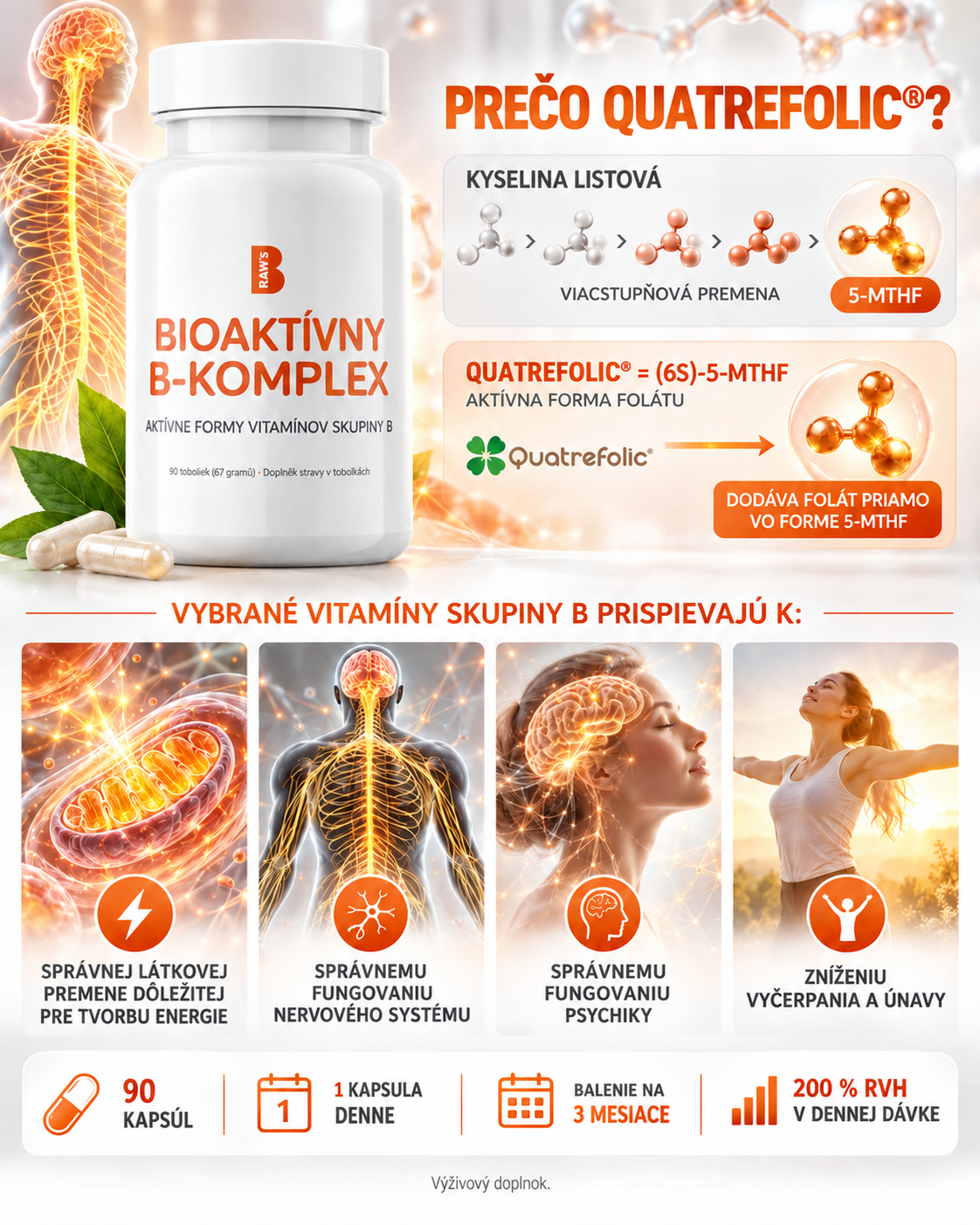
Bioactive B vitamin complex with the active form of folate Quatrefolic®. 90 plant-based capsules, with a recommended dosage of one capsule per day.
In stock
RAW’S / BIOACTIVE B-COMPLEX
Carefully Formulated Complex.
Active Forms of B Vitamins.
Bioactive B vitamin complex with the active form of folate Quatrefolic®. 90 plant-based capsules, with a recommended dosage of one capsule per day.
WHAT MAKES IT DIFFERENT
B Vitamins
✦
◇
◎
PRODUCT AT A GLANCE
RAW’S B-Complex
| Pack size | 90 capsules |
|---|---|
| Dosage | 1 capsule daily |
| Folate | Quatrefolic® |
| Capsules | Plant-based |
IN THE DETAILED DESCRIPTION
RAW’S Bioactive B-Complex
A thoughtfully formulated B vitamin complex without unnecessarily high doses. One capsule contains 200% of the nutrient reference value for each of the B vitamins. At the recommended dosage, the 90-capsule pack lasts three months.
Contains biologically active forms of B vitamins, including Quatrefolic® folate. Contains no synthetic additives, artificial colourings or animal-derived ingredients. The ingredients used are neither genetically modified nor irradiated. The capsules are plant-based.
B vitamins perform many interconnected functions in the body. Bringing them together in one complex makes it easy to supplement the entire group in a single daily serving.
Selected B vitamins contribute to:
-
- normal energy-yielding metabolism,
- normal energy-yielding metabolism,
-
- the normal functioning of the nervous system,
- the normal functioning of the nervous system,
-
- normal psychological function,
- normal psychological function,
-
- the reduction of tiredness and fatigue.
- the reduction of tiredness and fatigue.
Who Is B-Complex For?
-
- people with an active lifestyle,
- people with an active lifestyle,
-
- people experiencing increased physical or mental strain,
- people experiencing increased physical or mental strain,
-
- athletes,
- athletes,
-
- vegetarians and vegans,
- vegetarians and vegans,
-
- people who want to supplement B vitamins in biologically active forms,
- people who want to supplement B vitamins in biologically active forms,
-
- anyone who prefers a simple formula and plant-based capsules.
- anyone who prefers a simple formula and plant-based capsules.
Insufficient intake of one or more B vitamins can affect various processes in the body because individual vitamins perform different but interrelated roles.
Who Should Pay Particular Attention to Their B Vitamin Intake?
-
- people with a limited or nutritionally unbalanced diet,
- people with a limited or nutritionally unbalanced diet,
-
- vegetarians and vegans, particularly regarding vitamin B12 intake,
- vegetarians and vegans, particularly regarding vitamin B12 intake,
-
- older adults,
- older adults,
-
- people who have restricted their intake of certain foods over a long period,
- people who have restricted their intake of certain foods over a long period,
-
- people experiencing increased physical or mental strain.
- people experiencing increased physical or mental strain.
Most B vitamins are water-soluble, so regular intake through a varied, balanced diet is important. Vitamin B12 is a notable exception, as the body can store it. Food supplements do not replace a varied and balanced diet or a healthy lifestyle.
14 Possible Signs of Vitamin B12 or Folate Deficiency
Deficiency of individual B vitamins can manifest in different ways. However, the following symptoms are not specific and may have many other causes. On their own, they do not confirm a vitamin deficiency, which can only be reliably assessed through a medical examination and blood tests.
Possible signs of vitamin B12 or folate deficiency include:
-
- fatigue and a feeling of weakness,
- fatigue and a feeling of weakness,
-
- shortness of breath or rapid breathing,
- shortness of breath or rapid breathing,
-
- headaches,
- headaches,
-
- heart palpitations,
- heart palpitations,
-
- loss of appetite,
- loss of appetite,
-
- digestive problems,
- digestive problems,
-
- diarrhoea,
- diarrhoea,
-
- a sore or red tongue and mouth ulcers,
- a sore or red tongue and mouth ulcers,
-
- problems with memory, comprehension or judgement,
- problems with memory, comprehension or judgement,
-
- reduced sensation or numbness in the limbs,
- reduced sensation or numbness in the limbs,
-
- tingling in the hands or feet,
- tingling in the hands or feet,
-
- muscle weakness,
- muscle weakness,
-
- problems with balance and coordination,
- problems with balance and coordination,
-
- changes in mood, anxiety, confusion or other psychological difficulties.
- changes in mood, anxiety, confusion or other psychological difficulties.
Some neurological signs of vitamin B12 deficiency can occur even without anaemia. If you have persistent tingling, numbness, balance problems or memory changes, it is advisable to consult a doctor. NHS – symptoms of vitamin B12 or folate deficiency
B Vitamins and the Nervous System
Vitamin B1 contributes to the normal functioning of the nervous system, normal psychological function and normal energy-yielding metabolism.
Vitamins B6, B12 and folate contribute to normal homocysteine metabolism. Vitamin B12 is also involved in red blood cell formation, DNA synthesis and the normal functioning of the nervous system. However, elevated homocysteine levels alone are not proof of a specific vitamin deficiency, as other factors can also affect them. NIH – professional overview of vitamin B12
Deficiency Cannot Be Diagnosed From Symptoms Alone
The brain and nervous system may be among the areas affected by a vitamin B12 deficiency. In some cases, an untreated deficiency can lead to permanent neurological damage, making early professional diagnosis important. This food supplement is not intended to diagnose or treat vitamin deficiencies.
Below is a revised version with improved language and scientific accuracy. I have replaced the original recommended doses with nutrient reference values used in the EU. Values for pregnant and breastfeeding women have been removed because these are not uniform values used on EU food supplement labels.
Stability of B Vitamins
B vitamins may gradually deteriorate during manufacturing and storage. Their stability depends on the specific chemical form, temperature, light, oxygen, moisture, pH, packaging and product composition.
| Vitamin | NRV for adults | General sensitivity | Permitted physiological claims |
|---|---|---|---|
| Thiamine (vitamin B1) | 1.1 mg | Sensitive particularly to heat, alkaline environments, oxygen and moisture | Contributes to normal energy-yielding metabolism and the normal functioning of the nervous system, psychological function and heart function. |
| Riboflavin (vitamin B2) | 1.4 mg | Very sensitive to light; stability may also be affected by moisture | Contributes to normal energy-yielding metabolism, the maintenance of normal red blood cells, skin and vision, and the reduction of tiredness and fatigue. |
| Niacin (vitamin B3) | 16 mg | Relatively stable compared with other B vitamins | Contributes to the normal functioning of the nervous system, normal psychological function, the maintenance of normal skin and mucous membranes, and the reduction of tiredness and fatigue. |
| Pantothenic acid (vitamin B5) | 6 mg | Sensitive particularly to heat, moisture and strongly acidic or alkaline environments | Contributes to normal energy-yielding metabolism, normal mental performance and the reduction of tiredness and fatigue. |
| Vitamin B6 | 1.4 mg | Sensitive to light and heat; stability is also affected by processing methods | Contributes to the normal functioning of the nervous and immune systems, normal homocysteine metabolism, the regulation of hormonal activity and the reduction of tiredness and fatigue. |
| Folate (vitamin B9) | 200 μg | Sensitive to heat, light, oxygen and unsuitable pH | Contributes to normal blood formation, normal homocysteine metabolism, normal psychological function, maternal tissue growth during pregnancy, and the reduction of tiredness and fatigue. |
| Biotin (vitamin B7) | 50 μg | Stability can be affected by unsuitable processing and storage conditions | Contributes to normal energy-yielding metabolism, the normal functioning of the nervous system, normal psychological function and the maintenance of normal hair, skin and mucous membranes. |
| Vitamin B12 | 2.5 μg | Sensitive to light, heat, oxygen and unsuitable pH; contact with certain metals may also affect stability | Contributes to normal energy-yielding metabolism, the normal functioning of the nervous and immune systems, red blood cell formation, cell division and the reduction of tiredness and fatigue. |
The NRVs shown are used for labelling foods and food supplements in the EU. They are not individual recommendations for pregnant or breastfeeding women. Regulation (EU) No 1169/2011 – Annex XIII
Functions of B Vitamins in the Body
B vitamins perform various interconnected functions in the body. Their deficiency cannot be diagnosed from subjective symptoms alone; a reliable assessment requires a professional examination.
-
- Thiamine – vitamin B1: contributes to normal energy-yielding metabolism and the normal functioning of the nervous system, psychological function and heart function.
- Thiamine – vitamin B1: contributes to normal energy-yielding metabolism and the normal functioning of the nervous system, psychological function and heart function.
-
- Riboflavin – vitamin B2: contributes to normal energy-yielding metabolism, the protection of cells from oxidative stress and the reduction of tiredness and fatigue.
- Riboflavin – vitamin B2: contributes to normal energy-yielding metabolism, the protection of cells from oxidative stress and the reduction of tiredness and fatigue.
-
- Niacin – vitamin B3: contributes to the normal functioning of the nervous system, normal psychological function, the maintenance of normal mucous membranes and skin, and the reduction of tiredness and fatigue.
- Niacin – vitamin B3: contributes to the normal functioning of the nervous system, normal psychological function, the maintenance of normal mucous membranes and skin, and the reduction of tiredness and fatigue.
-
- Pantothenic acid – vitamin B5: contributes to normal energy-yielding metabolism, normal mental performance, and the normal synthesis and metabolism of steroid hormones, vitamin D and some neurotransmitters.
- Pantothenic acid – vitamin B5: contributes to normal energy-yielding metabolism, normal mental performance, and the normal synthesis and metabolism of steroid hormones, vitamin D and some neurotransmitters.
-
- Vitamin B6: contributes to normal homocysteine metabolism and normal protein and glycogen metabolism, the normal functioning of the nervous and immune systems, and the regulation of hormonal activity.
- Vitamin B6: contributes to normal homocysteine metabolism and normal protein and glycogen metabolism, the normal functioning of the nervous and immune systems, and the regulation of hormonal activity.
-
- Biotin – vitamin B7: contributes to normal macronutrient metabolism, the normal functioning of the nervous system, normal psychological function and the maintenance of normal hair, skin and mucous membranes.
- Biotin – vitamin B7: contributes to normal macronutrient metabolism, the normal functioning of the nervous system, normal psychological function and the maintenance of normal hair, skin and mucous membranes.
-
- Folate – vitamin B9: contributes to normal blood formation, normal homocysteine metabolism, normal psychological function, cell division and maternal tissue growth during pregnancy.
- Folate – vitamin B9: contributes to normal blood formation, normal homocysteine metabolism, normal psychological function, cell division and maternal tissue growth during pregnancy.
-
- Vitamin B12: contributes to the normal functioning of the nervous and immune systems, normal red blood cell formation, normal homocysteine metabolism, cell division and the reduction of tiredness and fatigue.
- Vitamin B12: contributes to the normal functioning of the nervous and immune systems, normal red blood cell formation, normal homocysteine metabolism, cell division and the reduction of tiredness and fatigue.
Note: Choline is sometimes informally referred to as vitamin B8, but it is not officially classified as a B vitamin. Claims about its effects may be made for a product only if choline is actually included in its composition and the amount meets legal requirements.
Contents and Dosage
Contents: 90 capsules – three-month supply
Recommended dosage: 1 capsule daily
Illustrative product infographic:

Product reviews
Product discussion
There are no questions yet.
Reviews
There are no reviews yet.